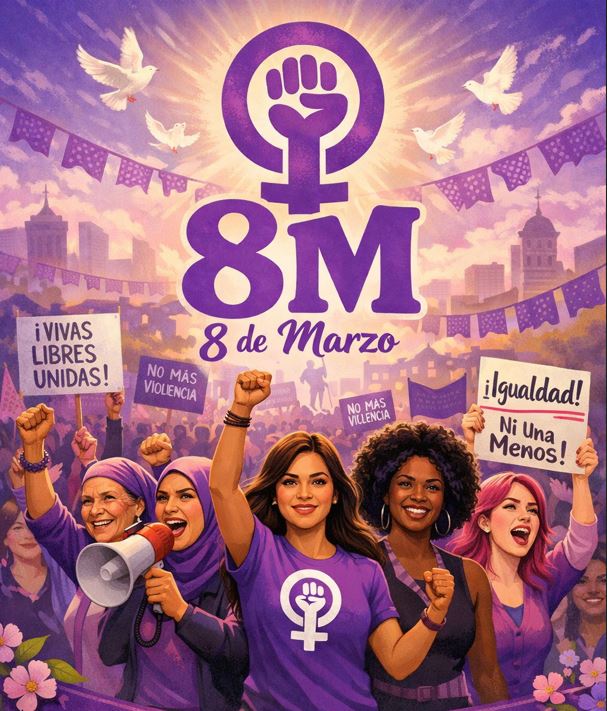
March 8th. Today and always!

March 8th is not just a date. It is a heartbeat. A heartbeat that moves across generations, echoing through streets dressed in purple, in classrooms where girls dream without asking for permission, in offices, in homes, in every space where a woman chose not to resign herself. It is not simply a day marked on the calendar; it is living memory, it is wound and it is hope.
Its story begins amid the smoke and roar of textile factories, where working women — exhausted yet determined — raised their voices to demand something as simple as it was revolutionary: dignity. In the late 19th and early 20th centuries, in cities like New York, thousands took to the streets calling for labor rights and the right to vote. Those voices, which many tried to silence, began weaving a collective awareness that would no longer be stopped.
In 1910, in Copenhagen, the German activist Clara Zetkin proposed dedicating an international day to women’s struggle. It was not a symbolic gesture; it was a political statement. Years later, March 8th became firmly etched in history following the mobilizations of women workers in Russia in 1917, who demanded not only bread and peace but also sparked profound political change. In 1975, the United Nations officially recognized the date, giving it a global dimension that could no longer be ignored.
Since then, International Women’s Day has become both a necessary and uncomfortable mirror. It reflects how much has been achieved… and how much still remains to be won.
In Spain, the transformation has been profound. There was a time when women needed marital permission to work or open a bank account. Today, there are equality laws and legislation protecting against gender-based violence; women lead ministries, conduct research in laboratories, run companies, and shape culture. The historic feminist strikes of 2018 and 2019 filled the squares and proved that equality is no longer a marginal conversation, but a central, urgent, collective issue.
Across the world, progress is also palpable: more girls have access to education, more countries recognize equality under the law, more women occupy positions of power and decision-making. They pilot airplanes, develop vaccines, report the news, govern nations. Language evolves, perspectives broaden, and long-standing structures — however slowly — begin to shift.
Yet March 8th is not a complacent celebration. It is also a warning.
Wage gaps persist, as do glass ceilings and sticky floors. Violence against women remains a devastating reality. Millions of girls still face barriers to education. The responsibility of care work is still not equally shared. And every crisis — whether sanitary, economic, or armed — reminds us how fragile rights can be when they are not firmly protected.
March 8th is the memory of those who fought when doing so meant risking everything. It honors those who never appeared in history books but changed history through everyday courage. And above all, it is about the future: a call to new generations to imagine a world where gender does not define limits or determine destinies.
It is not a day against anyone. It is a day in favor of everyone.
An invitation to review structures, question habits, and open new paths.
A reminder that history is still being written.
Because every right that seems obvious today was once an act of bravery.
And because equality is not a fixed destination — it is a living process, built each day with memory, awareness, and action.